How to say “Hello” in Russian
Discover the various ways to say hello in Russian and kickstart your conversations with confidence to make a memorable first impression.
Read →
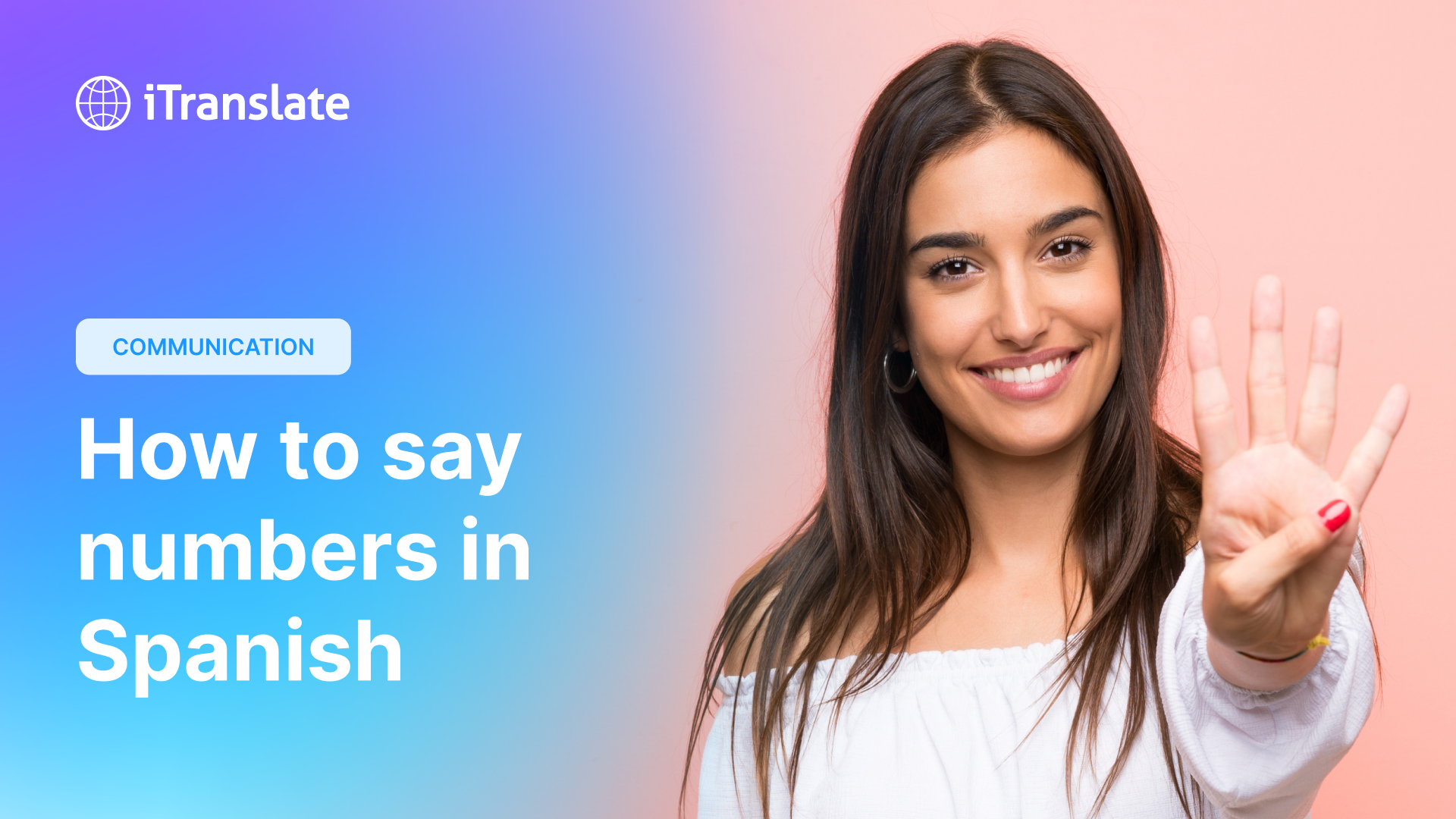
Hoping to learn the basics of counting in Spanish? That's a whole lot more than "uno, dos, tres." It's about being able to interact effectively, navigate your way around Spanish-speaking countries, and, yes, even show off a bit of your language literacy. Whether you're starting from scratch or have some Spanish under your belt, knowing your numbers can significantly boost your confidence in the language.
In this article, we're stepping into all things Spanish numbers — from the basics to some more nuanced stuff. We'll cover it all. You’ll be equipped with all the ins and outs of Spanish numeracy, ready to handle any number-related scenario. So let's not wait any longer and start boosting your Spanish number skills today. Ready to roll? ¡Vamos!
First, let's get familiar with two key terms: cardinal and ordinal numbers. Cardinal numbers, such as uno, dos, and tres (one, two, three) answer the question "how many?" Ordinal numbers like primero, segundo, and tercero (first, second, third) tell us the position or order of things. Both types play a huge role in everyday language use.
First things first, let's start with the basics: numbers 0-10.
| Number | Spanish Translation | Pronunciation |
|---|---|---|
| 0 | cero | 'se-ro |
| 1 | uno | 'oo-no |
| 2 | dos | dos |
| 3 | tres | tres |
| 4 | cuatro | 'kwah-tro |
| 5 | cinco | 'seen-ko |
| 6 | seis | sais |
| 7 | siete | 'syeh-te |
| 8 | ocho | 'o-cho |
| 9 | nueve | 'nweh-ve |
| 10 | diez | dyehz |
Now, let's step it up a notch with numbers 11-20. They're a bit trickier, but with a bit of practice, you’ll have them in no time.
| Number | Spanish Translation | Pronunciation |
|---|---|---|
| 11 | once | 'on-seh |
| 12 | doce | 'do-seh |
| 13 | trece | 'treh-seh |
| 14 | catorce | ka-'tor-seh |
| 15 | quince | 'kin-seh |
| 16 | dieciséis | dyeh-see-'say-ees |
| 17 | diecisiete | dyeh-see-'syeh-teh |
| 18 | dieciocho | dyeh-see-'o-cho |
| 19 | diecinueve | dyeh-see-'nweh-veh |
| 20 | veinte | 'vain-teh |
When you reach 21, things start to follow a pattern. From 21 to 29, Spanish numbers are like a combo of their components. So, "21" becomes "veintiuno" (veinte + uno).
| Number | Spanish Translation | Pronunciation |
|---|---|---|
| 21 | veintiuno | vein-'tee-oo-no |
| 22 | veintidós | vein-tee-'dohs |
| 23 | veintitrés | vein-tee-'trehs |
| 24 | veinticuatro | vein-tee-'kwah-tro |
| 25 | veinticinco | vein-tee-'seen-koh |
| 26 | veintiséis | vein-tee-'say-ees |
| 27 | veintisiete | vein-tee-'syeh-teh |
| 28 | veintiocho | vein-tee-'oh-choh |
| 29 | veintinueve | vein-tee-'nweh-veh |
| 30 | treinta | 'treh-een-tah |
Counting from 31-100 becomes more intuitive. It's all about putting together the tens and the units with a conjunction in between (y, which means "and"). For example, 31 is "treinta y uno" (thirty and one).
| Number | Spanish Translation | Pronunciation |
|---|---|---|
| 31 | treinta y uno | 'treh-een-tah ee oo-noh |
| 32 | treinta y dos | 'treh-een-tah ee dohs |
| (and so on!) | ... | ... |
| 40 | cuarenta | kwa-'ren-tah |
| 50 | cincuenta | seen-'kwen-tah |
| 60 | sesenta | seh-'sen-tah |
| 70 | setenta | seh-'ten-tah |
| 80 | ochenta | oh-'chen-tah |
| 90 | noventa | noh-'ven-tah |
| 100 | cien | syen |
Here's a handy trick: If you're counting by tens, you only need to know the numbers 10 (diez), 20 (veinte), 30 (treinta), 40 (cuarenta), 50 (cincuenta), 60 (sesenta), 70 (setenta), 80 (ochenta), 90 (noventa), and 100 (cien).
As we advance, it's worth noting that Spanish, like many languages, uses commas and decimal points differently than English. In Spanish-speaking countries, a comma often indicates a decimal point, and a period or space is used to mark off thousands. So, 1,000 would be written as 1.000 or 1 000.
Counting by hundreds (cien, doscientos, trescientos, etc.) is a practical skill for larger numbers and for understanding money in Spanish-speaking countries. So now, let's tackle the hundreds:
| Number | Spanish Translation | Pronunciation |
|---|---|---|
| 101 | ciento uno | syen-toh oo-noh |
| 200 | doscientos | dohs-syen-tos |
| 300 | trescientos | trehs-syen-tos |
| 400 | cuatrocientos | kwah-troh-syen-tos |
| 500 | quinientos | kee-nee-en-tos |
| 600 | seiscientos | say-syen-tos |
| 700 | setecientos | seh-teh-syen-tos |
| 800 | ochocientos | oh-choh-syen-tos |
| 900 | novecientos | noh-veh-syen-tos |
| 1000 | mil | meel |
We're not going to list out all the numbers from 1,000 to 1,000,000 here because that would be quite a marathon read! But there’s a straightforward pattern that you can follow to understand and construct these larger numbers in Spanish. Let's break it down:
The first step is to remember that the word for "thousand" in Spanish is "mil." To count thousands in Spanish, we simply say the number from one to one thousand (which you've already learned), followed by "mil." For example, "dos mil" is "two thousand" (2,000), "tres mil" is "three thousand" (3,000), and so on.
In Spanish, there's no need to pluralize "mil" no matter how many thousands you're talking about. It stays "mil," not "miles." Neat, right?
Now, what about the numbers in between the thousands? Well, these are just as easy. If you want to say "2,500," in Spanish, you would say "dos mil quinientos." It's basically the thousands, followed by the numbers up to 999.
We've got one more big leap to make – reaching a million! The Spanish word for "million" is "millón," and just like "mil," the smaller numbers precede it. So "un millón" is "one million," "dos millones" is "two million," and so on. Note that "millón" does get pluralized – it becomes "millones."
Numbers over a million maintain the same rules, though they're not as commonly used in everyday conversation. Here's the overview of those numbers in Spanish:
1,000,000 - un millón
2,000,000 - dos millones
1,000,000,000 - mil millones
1,000,000,000,000 - un billón
Learned the art of counting in Spanish? Check. Now, it's time to place those newly learned numbers into action. This section is about the practical use of numbers in your everyday Spanish interactions — from clock-watching and calendar-reading, to birthday celebrations, and shopping.
Telling time in Spanish is essential, and you've already learned the necessary numbers. Remember, we usually use "Es la…" for one o'clock and "Son las…" for other hours. For example:
It's one o'clock - Es la una
It's two o'clock - Son las dos
…and so on!
In Spanish-speaking countries, the day comes before the month when saying the date. So, July 29 would be "veintinueve de julio." Also, when referring to the first day of the month, we use "primero," not "uno." So, July 1 would be "primero de julio."
When talking about age, use "tener," which means "to have." For example, "I'm 30 years old" would be "Tengo treinta años."
Knowing numbers will aid in everyday activities such as shopping or asking for directions. Also, being familiar with numbers will help you understand and use basic math in Spanish.
When shopping, it's necessary to understand prices. Remember that in Spain and many Latin American countries, a comma is used as a decimal point, and a period or space is used to separate thousands.
Idioms and sayings with a figurative meaning different from their literal interpretation, are prevalent in every language, including Spanish. Here are some idioms that involve numbers:
"Estar en las nubes" - Literally, "to be in the clouds," means to be daydreaming or not paying attention.
"No tener dos dedos de frente" - Literally, "not to have two fingers of forehead," means someone is not very smart.
"Cuesta un ojo de la cara" - Literally, "it costs an eye from the face," means something is very expensive.
Alright, let's switch gears a bit. We've walked you through the essentials of Spanish numbers, and now it's time to discuss some strategies to help you retain them.
To remember numbers better, try mnemonic devices. These memory tools often involve making a rhyme or a phrase where each word starts with the same letter as the thing you're trying to remember. For example, to remember "tres" (three), you might think of a tree shaped like the number 3.
Practice makes (almost) perfect! Try out some activities like flashcards, online quizzes, or simply counting objects around you in Spanish.
It's your turn now! Bring your Spanish number knowledge to life using iTranslate. Start by exploring the Spanish language on the iTranslate website or download the iTranslate app for an on-the-go learning experience. You're just a click away from unlocking a new world of numerical literacy!
Why stop with numbers? Visit our blog to learn the magic of 'hola', 'buenos días', and 'gracias'.